
Leave A Message
If you are interested in our products and want to know more details,please leave a message here,we will reply you as soon as we can.

Lots of temperature chamber benchtop customization projects end up with unsatisfied testing performance due to mismatched core configuration, improper component selection and non-targeted structural design.
Today, you will explore a complete guideline on how to customize benchtop temperature and humidity chambers for any lab and industrial testing project. From requirement confirmation, core configuration selection, chamber dimension definition, manufacturing & assembly techniques.
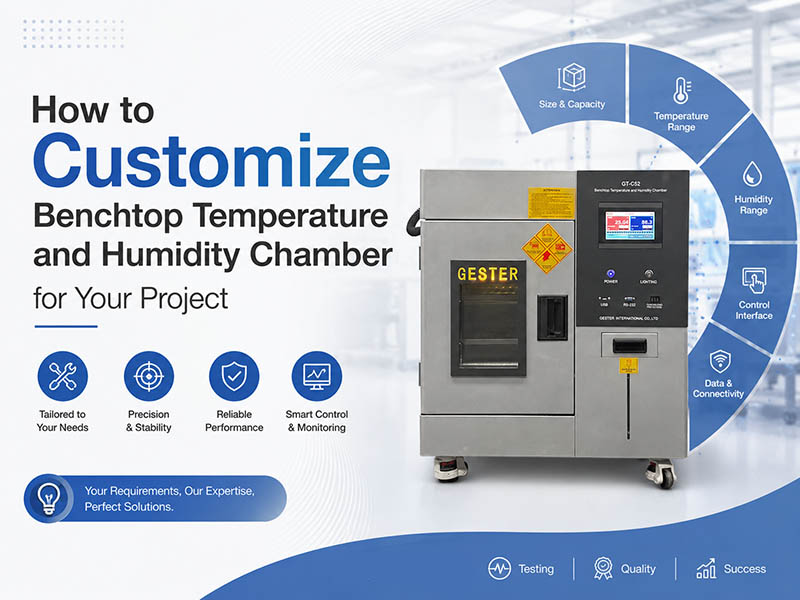
Customized benchtop environmental chambers are tailored with exclusive parameter settings and structural layouts to match unique sample testing requirements across multiple industries.
The full customization route starts with clarifying project testing requirements, selecting matching core component grades, defining inner & outer chamber dimensions, finishing precision manufacturing and assembly, then adding customized surface treatments.
We split the full customization into 5 clear sequential steps:
Step 1: Specify your Project’s Needs
Your customization starts with full definition of actual testing requirements, first confirming target application fields: the customized chamber is for electrical & electronic product reliability test, mechanical parts environmental screening or general material pre-test conditioning before lab inspection.
You can consult our technical engineers anytime for detailed requirement communication.
Step 2: Choose the Right Grade of Benchtop Chamber Core Configuration
Benchtop temperature test chambers rely on matched refrigeration, humidification, sensing and control assemblies to realize programmable high-low temperature alternating test and constant temperature & humidity conditioning for various samples. Each core component grade directly determines chamber precision, stability and service life, though chamber design also faces constraints like compressor heat emission, inner chamber condensation risk and sensor drift under extreme low-temperature environment.
Step 3: Confirm Benchtop Chamber Internal Volume & Outer Dimension
Inner effective volume and outer cabinet dimension are decisive indicators to match your sample loading quantity, specimen size and lab desktop placement limitation, also directly affecting airflow circulation uniformity inside test compartment. All customized dimension design shall comply with mainstream industry specification benchmarks:
IEC 60068 (international environmental test standard for electronic products) defines effective inner space design rule: total sample volume shall not exceed 35% of chamber inner usable volume;
GB/T 10586-2013 specifies the gap distance between sample outer surface and inner chamber wall for uniform temperature distribution.
Different industries follow unique safety and placement standards for benchtop size design; core factors deciding customized chamber dimension include:
Step 4: Choose a Suitable Manufacturing & Assembly Technique
Custom benchtop environmental chamber production covers cabinet shell fabrication, inner chamber processing, core refrigeration/humidity system matching, control system integration and final mechanical assembly; each fabrication technology decides finished equipment precision, air tightness and long-term operational stability.
Step 5: Apply Internal & Exterior Surface Finishing on Benchtop Chamber
Proper surface finishing is an indispensable customization step to improve chamber anti-corrosion ability, appearance and long-term operating durability; inner and outer parts adopt differentiated finishing solutions per working environment.
After all finishing and full assembly, strict QC inspection is compulsory for customized benchtop chamber before delivery.
Why Choose GESTER for your Custom Benchtop Temperature and Humidity Chamber
As a professional China-based custom benchtop temperature and humidity chamber manufacturer, GESTER has invested in advanced CNC processing, precision assembly and aging test equipment to deliver fully tailored desktop environmental chambers with customized dimension, parameter and auxiliary functions while maintaining competitive factory-direct pricing.
We guarantee flexible MOQ arrangement and fast production turnaround for all customized chamber orders regardless of small-batch lab prototype or bulk industrial procurement demand.
Conclusion
Custom-made benchtop temperature and humidity chambers deliver targeted testing performance without users investing in complex independent component research and assembly. More laboratories and manufacturing enterprises choose customized finished chambers rather than purchasing standard off-the-shelf equipment and later reforming structure by themselves to satisfy unique high-low temperature alternating test and pre-sample conditioning needs.
At GESTER, our professional R&D and production team helps streamline your whole customization project and realize fully personalized benchtop chamber matching all your testing specifications.
FAQs
How do you Choose a custom Benchtop Temperature and Humidity Chamber Fabrication Partner?
You need to assess the supplier’s industry experience, core R&D capability, complete processing equipment inventory, past finished customized chamber project cases, formal factory certification and production delivery cycle; arrange factory site inspection for long-term large-quantity cooperative procurement if possible.
What are the Common Challenges in Benchtop Chamber Customization?
Typical customization difficulties include inner chamber condensation under extreme temperature difference, temperature uniformity deviation caused by unreasonable airflow design, controller program mismatch with user’s customized test curve and sealing aging leading to humidity control drift during long-term cycling test.
What is your MOQ for Custom-made Benchtop Temperature and Humidity Chambers?
Normally our standard MOQ starts from 1 unit for custom benchtop chamber, and we provide flexible quantity adjustment based on customized parameter complexity, inner volume and additional auxiliary functions.
What are the Core Applications of Custom Benchtop Temperature and Humidity Chambers?
Customized desktop chambers are widely used for pre-test sample conditioning and high-low temperature alternating cycling reliability test of electrical, electronic components, mechanical spare parts, polymer and new material products to verify product quality and environmental adaptability under simulated varied temperature & humidity lab conditions.
leave a message
Scan to wechat :

Scan to Whatsapp :