
Leave A Message
If you are interested in our products and want to know more details,please leave a message here,we will reply you as soon as we can.

With a constant temperature humidity chamber, you can reproduce real‑world temperature and humidity environments to validate product reliability and stability.
In this guide, we are going to explore everything about constant temperature humidity chambers. Besides, you will also learn how to choose a suitable chamber, core technical specifications, typical applications, control systems, capacity options among other vital aspects.
So, before selecting your next temperature humidity test chamber for lab or production testing, read this guide.
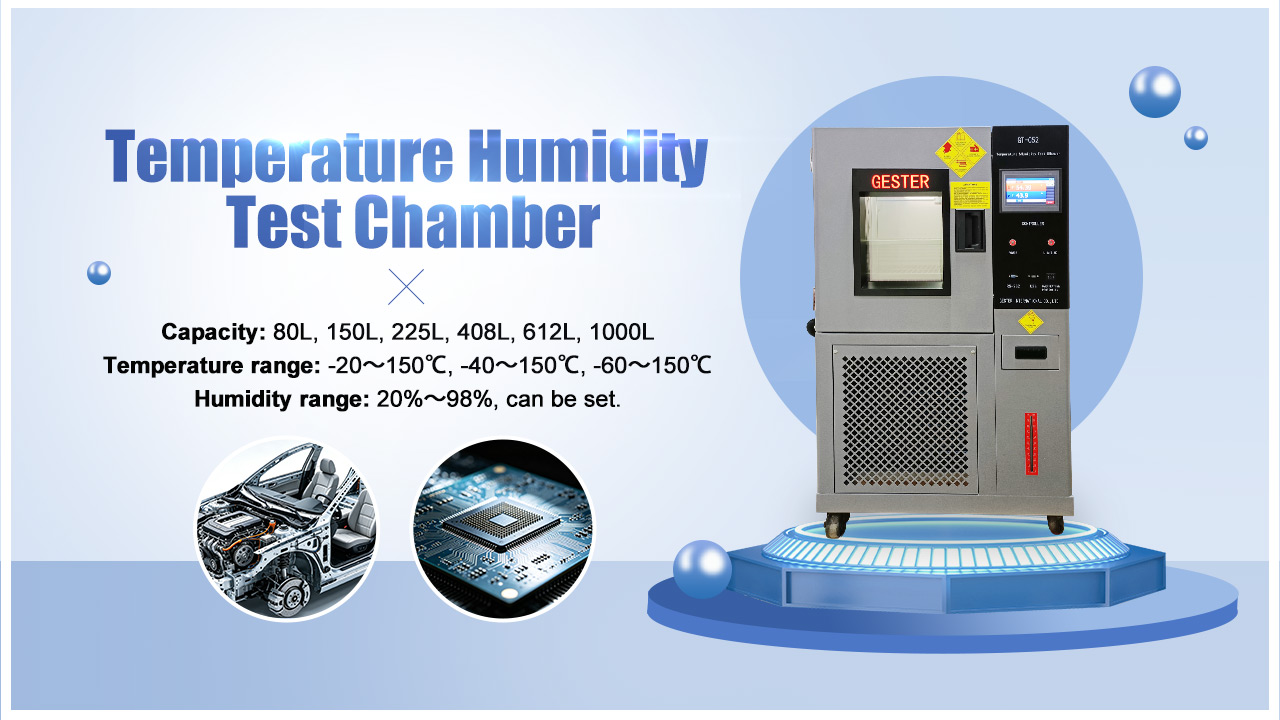
What is the temperature humidity chamber
GESTER temperature and humidity chamber can simultaneously simulate various temperature and humidity conditions in programmable cycles for environmental testing. Testing on samples helps improve product reliability and reduce risks associated with new product development. It has become essential core equipment in electronics, automotive, aerospace, medical, energy and other industries.
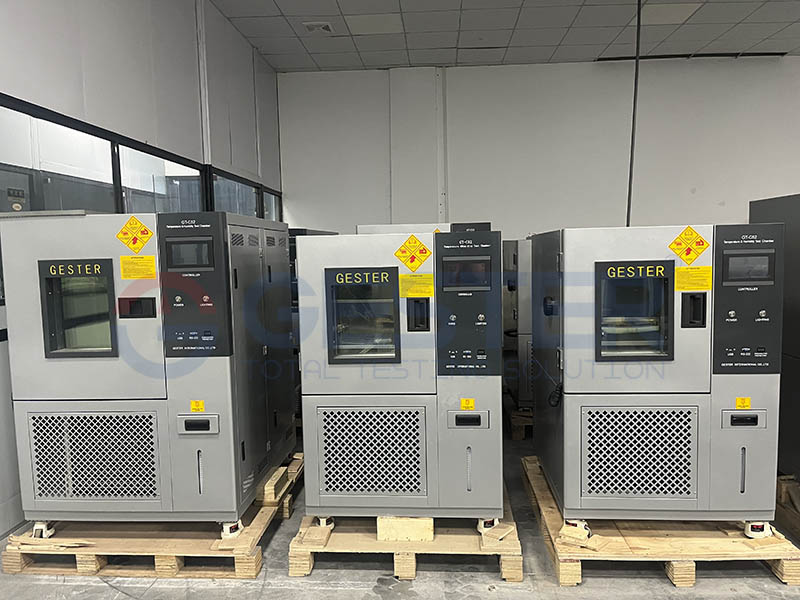
Constant Temperature Humidity Chamber Operations
As impressive as a temperature humidity test chamber is as a testing equipment, you cannot hide from the complexity of programming it correctly. Some of its remarkable features present operational challenges, hence necessitating a clear understanding of key operations, including:
· Programming Test Cycles
Programming manipulates the operation of your chamber by subjecting it to a series of setpoint instructions as it runs on its controller. It attempts to give your final test profile a structured form, including ramping, soaking, and cycling.
Benefits
· Selecting Appropriate Test Space
This essential planning operation leaves you with the right chamber capacity for your products, and it only utilizes the internal dimensions (Width x Depth x Height) to make your prescribed choice.
For more effective testing, you can match your product size to the appropriate chamber model.
| Capacity | 80L | 150L | 225L | 408L | 612L | 1000L |
|
Inside dimension WxDxH(cm) |
40x40x50 | 50x50x60 | 75x60x50 | 80x60x85 | 80x85x90 | 100x100x100 |
|
Outside dimension WxDxH(cm) |
91x100x139 | 100x110x149 | 125x120x139 | 130x122x182 | 130x153x190 | 150x167x189 |
Benefits
· Setting Temperature & Humidity Specifications
Setting parameters on your chamber should only be undertaken with a clear understanding of your test requirements. This will keep your test valid by averting conditions that may lead to false pass or fail results.
You can undertake this operation to instill specific climatic conditions, such as high-temperature storage or damp heat testing. For effective testing, you should first understand the applicable standards for your product before settling on setpoints.
| Temperature range | -20~150℃, -40~150℃, -60~150℃ optional (can be custom-made) | ||
| Humidity range | 20%~98%, can be set. | ||
| Rate of temperature increasing |
Room temperature~150℃ For heating in average (without loading) |
About 45 mins | About 3.5℃/min |
|
Room temperature~-20℃ For cooling in average (without loading) |
About 45 mins | About 1.2℃/min | |
| Machine precision |
Control accuracy (test precision)
|
Temperature | ±0.5℃ |
| Humidity | ±1%RH | ||
| Distribution accuracy (uniformity) | Temperature | ±1.0℃ | |
| Humidity |
±2%RH |
||
Benefits
· Utilizing the Control System
The control system requires you to focus on the touch screen interface where you want to input your test profile. This consequently leads to the execution of your programmed sequences.
You can rely on the Touch screen, 680 temperature controller which features an LCD programmable display. The control mode is a touch pad for easy operation.
System capacity: 120 groups program X 100 sections. Required segmentation sections of each group can be arbitrarily divided, and each program can freely link to another.
Cycle setting: each operation procedure can carry out 9999 times or heaps of times cycle and repeated performance, and to the degree, divide further 5 segmentation sections to do part cycle of the extra.
Benefits
Benefits of Constant Temperature Humidity Chamber
Be it in electronics manufacturing or aerospace component validation, the constant temperature humidity chamber has always been highly appreciated. This unique temperature humidity chamber promises an array of distinct upsides, including:
Testing with a constant temperature humidity chamber promises superior-quality finished products characterized by reliability and durability under extreme climates.
It allows you to craft unique environmental test sequences in line with your specific product use requirements.
During testing, you are less likely to experience condition deviations that can invalidate your results or degrade your test sample.
Accelerated testing hardly requires you to run tests for the product’s entire expected life, as the chamber organically generates accelerated stress conditions.
The repeatability of the chamber is mirrored in the resulting test data, which demonstrates high consistency across multiple test runs.
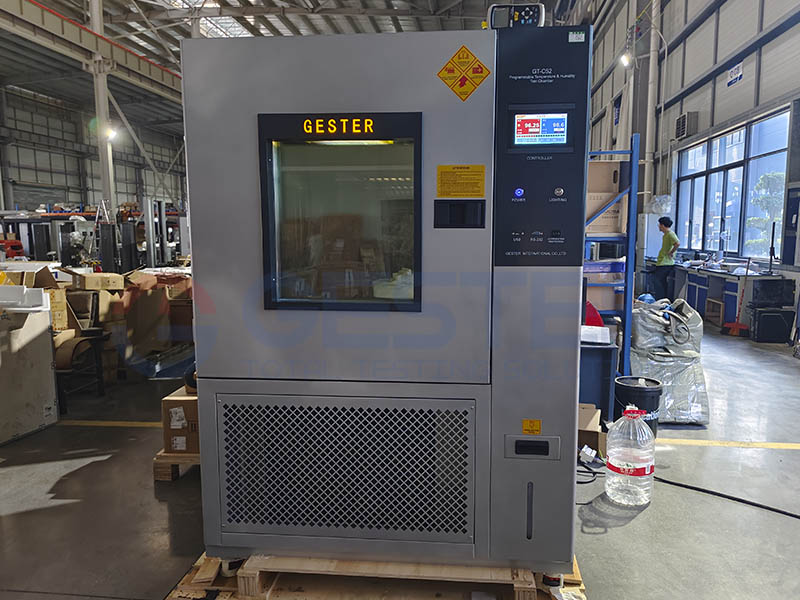
How to Effectively Use Your Constant Temperature Humidity Chamber
Setting a test profile and running a valid test requires you to apply a high level of know-how. Here are foolproof pointers to help you process your testing with ease and utmost efficiency.
Always place test samples with adequate spacing to allow for proper air circulation within the chamber.
The specific steps are as follows:
1. Connect power line to Miniature circuit breaker.
(L-Live wire; N-Neutral wire; PE-protective earthing conductor)
2. Turn on.(On the back of machine)
3. Add pure water(12-13L) into tank. The water level shall be about 80.
1st tube: test temperature;
2nd tube: the alarm for excessive temperature;
3rd tube: test humidity.
4. Open the door, fixed the cotton cloth on the third sensing tube.
Another side is placed on the small sink,
Another side shall be placed on the small sink, make sure to water can be absorb to sensing tube.
5. Place specimens on holder, and close the door.
6. Press “POWER” button, to enter Main Interface. On first one(LANGUAGE), choose “English”.
7. Choose testing method accord to need (“OPER.SCREEN” and “PROG SET”).
8. OPER.SCREEN:
Set time, temperature and humidity.
Click “START” to running.
9. When the set time is reached, take out the specimens.
10. Close the door and power.
Typical Industries & Applications
Constant temperature humidity chambers are essential in industries requiring environmental reliability testing.
· Electronics & Semiconductor
Test circuit boards, chips, sensors, and connectors under temperature/humidity stress.
· Automotive
Validate electromechanical components, batteries, and interior materials.
· Aerospace & Defense
Test high‑reliability components and materials under extreme climates.
· Pharmaceutical & Medical
Verify drug stability, packaging barrier properties, and device reliability.
· Energy & Power
Test batteries, fuel cells, photovoltaic modules, and energy materials.
· Other Applications
Materials science, packaging, consumer electronics, communications, and new product development.
FAQS On Temp Humidity Chamber
What is the Requirement of ambient air quality
Do not contain high concentration dust and flammable gas, without strong electromagnetic radiation source nearby.
What is a Constant Temperature and Humidity Chamber?
A constant temperature and humidity test chamber is a device designed to simulate continuous temperature and humidity testing conditions. It typically consists of a sealed test chamber, heating and cooling systems, humidification and dehumidification systems, and a temperature and humidity control system. Consequently, it is capable of providing precise control over temperature and humidity, making it possible to test the performance of various materials, products, or equipment under diverse environmental conditions.
Why Conduct Environmental Simulation Testing?
Unlike simple bench testing under ideal room conditions, this approach promises to expose your products to the real-world stresses they will actually face, making it your ideal solution for ensuring long-term reliability and safety.
What is the power requirement for the temperature humidity chamber?
AC1¢3W 380V 50/60HZ, voltage change allowed value: ±10% of fixed voltage.
leave a message
Scan to wechat :

Scan to Whatsapp :