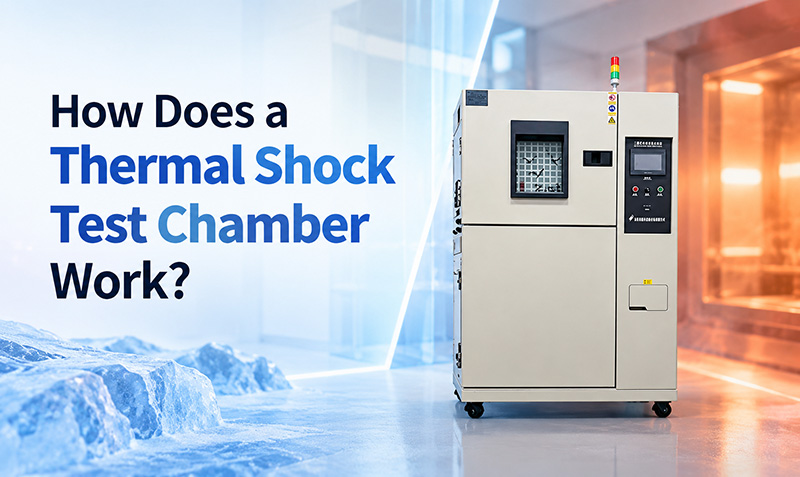
How Does a Thermal Shock Test Chamber Work?
Oct 24, 2026
Thermal shock test chambers are some of the most common types of testing equipment used to evaluate product reliability across many industries. As essential tools for thermal shock testing, they help manufacturers identify potential failures caused by rapid temperature changes.
However, successful testing depends on mastering how the unit operates, knowing its key specifications, appreciating its benefits, and identifying the materials you wish to test. This is what you are going to learn in this article.
What Is a Thermal Shock Test Chamber?
A thermal shock test chamber refers to testing equipment that assesses chemical changes or physical damage in materials when exposed to extreme, rapid temperature shifts.
You employ this equipment with the aim of attaining precise temperature variation, reliable test results, as well as simulating harsh real-world service conditions that are often suitable for product validation.
Capable of accelerating failure screening and saving costs, this type of thermal shock test equipment is an ideal solution for reliability testing.
How Does a Thermal Shock Test Chamber Operate?
In two-zone thermal shock testing, the equipment contains two fully independent compartments: a high-temperature chamber and a low-temperature chamber. The test specimen is placed inside a test basket or tray.
The basket will be rapidly transferred between the hot zone and cold zone to create abrupt temperature changes for the samples. Usually, this method facilitates the attainment of fast temperature transition cycles and repeatable test results since separate chambers keep target temperatures stable without re-heating or re-cooling for every cycle. This working principle is best suited for electronics, automotive parts, and composite materials for accelerated stress screening.
Compared with conventional temperature testing methods, a thermal shock testing machine is designed to expose samples to rapid temperature transitions, helping evaluate their resistance to thermal stress under controlled conditions.
Thermal Shock Testing Process: Step by Step
A thermal shock test follows a controlled procedure to expose test specimens to rapid temperature changes and evaluate their reliability.
Prepare the test specimens. Check the sample dimensions, condition, and quantity, and identify any initial defects before testing.
Set the test parameters. Define the high and low temperatures, dwell times, number of cycles, and other conditions according to the applicable test standard or product specification.
Stabilize the hot and cold chambers. Allow both zones to reach their target temperatures before starting the test.
Run the thermal shock cycles. The basket transfers the specimens between the hot and cold zones according to the programmed test procedure.
Inspect the specimens. After testing and any required recovery period, check for cracks, delamination, connection failures, dimensional changes, or other signs of damage.
The exact procedure depends on the test standard, specimen characteristics, and product qualification requirements. Following the specified conditions helps laboratories obtain more consistent and meaningful results.
Factors That Affect Thermal Shock Test Results
Several factors can influence the reliability and repeatability of thermal shock testing. Selecting the correct chamber is important, but the test setup and specimen conditions also matter.
Temperature range: The selected high and low temperatures should match the requirements of the applicable test method and the intended service environment.
Dwell time: Specimens need sufficient exposure to the specified temperature conditions. The required duration depends on the test procedure and the characteristics of the samples.
Sample size and loading: The dimensions, thermal mass, quantity, and placement of specimens can affect heat transfer and temperature response. Avoid exceeding the chamber's specified loading limits.
Temperature uniformity and recovery: Stable temperatures in both zones and appropriate temperature recovery help maintain consistent test conditions between cycles.
Test cycle and inspection criteria: The number of cycles and the criteria used to assess damage should be defined before testing. Different products may require different inspection methods, including visual inspection, dimensional checks, or electrical performance testing.
By controlling these variables, a thermal shock testing lab can improve test repeatability and better identify potential weaknesses in product design or material selection.
Advantages of Thermal Shock Test Chambers
High Quality and Test Accuracy
Through thermal shock testing, you can achieve sharp temperature differentials and strict temperature control limits. This makes the equipment suitable for reproducing extreme environmental stress in intricate components.
Enhanced Equipment Robustness and Durability
Well-built thermal shock equipment is designed to withstand repeated high- and low-temperature cycling. Durable construction and reliable operation help support long-term testing requirements under demanding laboratory conditions.
Precise Temperature Consistency
Another advantage of using a thermal shock tester is that it maintains stable temperatures inside the hot and cold zones, making it ideal for evaluating sample performance under harsh conditions. Reducing temperature deviations across the test space helps minimize inconsistent test results for components.
Versatility in Applications
Thermal shock test chamber units are versatile and used in the aerospace, semiconductor, automobile, and new-energy industries for product validation. You can use them for parts that require mechanical property checks, reliability screening, or both.
Key Specifications for GT-F56A Thermal Shock Chamber
You utilize the GT-F56A when you have requirements for a large test space, stable temperature uniformity, and reliable thermal shock cycling. This two-zone thermal shock chamber offers precise temperature control and is suitable for testing medium-sized samples. It is appropriate for aerospace, electronics, new energy battery, and automotive sectors since it balances testing performance and cost demands.
Outside dimensions (W × H × D): 1300 × 2050 × 1500 mm
Basket dimensions (W × H × D): 600 × 500 × 500 mm
High-temperature chamber range: RT +10~180℃
Low-temperature chamber range: -60~45℃
Temperature uniformity: ±2.0℃
Temperature fluctuation: ±0.5℃
When comparing thermal shock test chambers, buyers should consider temperature ranges, basket capacity, temperature uniformity, and cycling requirements to ensure the equipment matches their testing applications.
Applications of Thermal Shock Test Chambers
Aerospace Components
Thermal shock chambers are versatile and can be utilized in complex aerospace applications, including aerospace structural parts and defense industry components. These tests provide the benefits of stress simulation, failure detection, and accelerated evaluation.
Electronics and Semiconductors
Materials such as chips, PCB substrates, and semiconductors are suitable for testing with this equipment because of their sensitivity to abrupt temperature changes. A thermal shock test can help reveal potential defects in electronic assemblies and identify weaknesses that may affect long-term reliability.
New Energy Batteries
Thermal shock testing is ideal for new-energy battery samples during reliability screening, since they face large temperature swings in real service scenarios. Selecting appropriate testing conditions helps manufacturers evaluate battery components under simulated environmental stress.
Automotive and Mechanical-Electrical Products
Employ a thermal shock chamber when validating automotive and mechanical-electrical components to improve product quality, durability, and economic efficiency in reliability verification.
FAQs
Why Is a Thermal Shock Test Chamber Important for Product Testing?
Thermal shock test chambers are ideal for reliability validation since they create rapid, extreme temperature transitions and reveal hidden design flaws. They accelerate aging effects, support repeatable testing, and help manufacturers improve product safety. A thermal shock testing lab can use this equipment to validate many kinds of components under controlled temperature conditions.
What Is the Difference Between Thermal Shock and Thermal Cycling Testing?
Thermal shock transfers samples rapidly between pre-stabilized hot and cold zones to create abrupt temperature-gradient stress. Thermal cycling uses controlled temperature ramps, often inside one chamber, to expose samples to gradual temperature changes and thermal fatigue.
What Are the Signs of Thermal Shock?
Common signs include cracks, delamination, peeling, broken solder joints, seal leakage, open or short circuits, and intermittent electrical failure.
How Is Thermal Shock Testing Done?
Load samples into the basket. The basket moves quickly between stable hot and cold zones for programmed cycles. After testing, inspect the samples for signs of failure or physical damage.
How Do You Choose a Thermal Shock Chamber Supplier?
When comparing thermal shock chamber manufacturers and thermal shock chamber distributors, consider the equipment's temperature range, test capacity, applicable testing standards, technical support, and after-sales service. These factors help you select a suitable solution for your laboratory's testing requirements.
What Factors Affect Thermal Shock Chamber Price?
The thermal shock chamber price depends on factors such as chamber configuration, temperature range, test capacity, control system, and customization requirements. Comparing these specifications helps buyers evaluate equipment according to their application needs and budget.
Conclusion
Understanding how a thermal shock test chamber works helps manufacturers and laboratories select suitable test conditions, evaluate potential product weaknesses, and improve reliability verification.
The right equipment depends on your required temperature range, specimen dimensions, test cycle, and applicable testing standards. GESTER's GT-F56A Thermal Shock Chamber features a two-zone design for testing products under rapid high- and low-temperature transitions.
Looking for a suitable thermal shock testing solution? Explore the GT-F56A Thermal Shock Chamber or contact GESTER to discuss your sample specifications and testing requirements.
Related Products
Constant Temperature Humidity Chamber GT-C52
Rapid Temperature Change Test Chamber GT-F51
High Low Temperature Test Chamber GT-F58
Rapid Thermal Shock Three-Combined Environmental Test Chamber GT-F70
More Resources:
What Is Thermal Shock Tester? & Why it is Important
Thermal Shock Test Chamber: A Purchase Guide
Thermal Shock Chamber vs Rapid Temperature Change Test Chamber: What Is the Difference?
Thermal Shock Tester: Comprehensive Guide for Manufacturers
Read More