
Leave A Message
If you are interested in our products and want to know more details,please leave a message here,we will reply you as soon as we can.

In global industrial markets, product failures caused by extreme temperature alternations are a leading cause of customer complaints, reliability claims and returns. Even a minor physical deformation or performance drift after temperature shock can downgrade a product’s durability grade and lead to massive shipment rejections.
Modern thermal shock testing requires strictly controlled conditions that simulate real-world extreme temperature changes, including temperature range, switching speed, air circulation and environmental uniformity. A high-quality two-chamber thermal shock tester minimizes test variation, delivers consistent temperature accuracy. Therefore, selecting a suitable thermal shock test chamber is crucial.
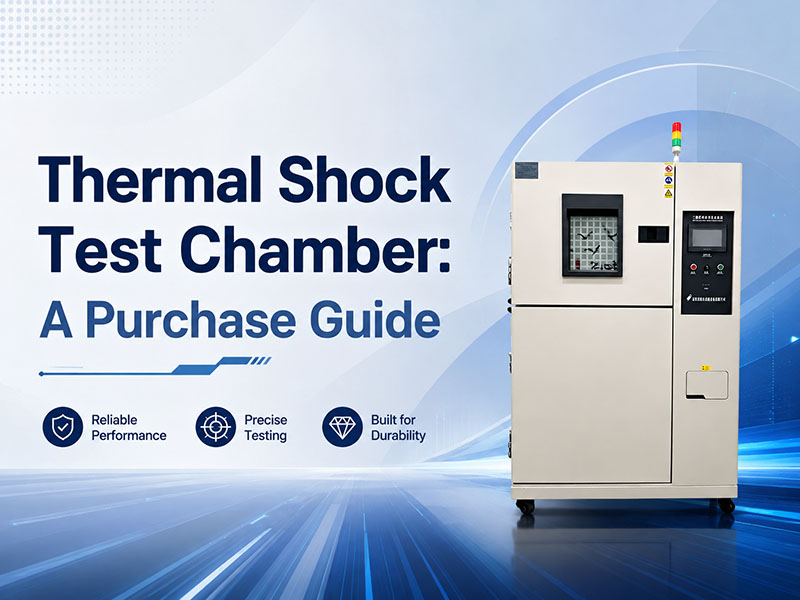
Thermal shock tester: Its primary purpose is to evaluate the physical changes and performance of materials under extreme temperature conditions. Thermal shock testing involves rapidly shifting a device under test (DUT) between two extremes—hence the ‘shock.’
It is a core reliability test widely adopted across electronics, electrical components, automation, communication, automotive, metal, chemical and plastics industries. It is also a mandatory compliance requirement under international and regional reliability standards.
Start by asking whether the chamber's thermal capability actually matches your product test requirements. Different industries call for different thermal stress conditions—electronic components, for example, typically need rapid exposure to extreme heat and cold to flush out latent failures caused by thermal stress, material expansion, and solder joint reliability issues.
Thermal shock chambers generally come in two‑chamber or three‑chamber configurations.
A two‑chamber chamber has separate hot and cold compartments with an automatic sample transfer mechanism—the test specimen moves between chambers via a basket system to achieve rapid temperature changes. The upside? Fast thermal transition and simpler maintenance compared to more elaborate setups.
A three‑chamber chamber, on the other hand, includes a hot chamber, a cold chamber, and a separate test chamber, where conditioned hot or cold air is introduced into the testing area through a controlled airflow system. Depending on the applicable standards and test procedures, some methods may even require an intermediate ambient chamber.
Thermal shock testing is all about subjecting products to sudden temperature swings—and the resulting rapid expansion and contraction create thermal stress. The real focus is whether that stress causes structural damage or performance failures: think glass items cracking from abrupt thermal differentials, or solder joints on electronic boards coming loose.
Reliable thermal shock testing demands stable, repeatable temperature control. That means paying close attention to two key metrics: temperature fluctuation and temperature uniformity.
Temperature fluctuation refers to how much the temperature deviates around the setpoint during steady‑state operation.
Temperature uniformity tells you whether every spot inside the chamber holds the same temperature—no hot or cold pockets.
Before you buy, take a hard look at the manufacturer's capabilities. Choosing an experienced thermal shock chamber supplier goes a long way toward ensuring reliable performance over the equipment's lifetime. Look for companies with a proven track record in the industry—their depth of experience often translates into better build quality and more knowledgeable support.
Support services offered by thermal shock chamber manufacturers also play a significant role. Consider the availability of technical assistance.
• Fast Response and Delivery: We fully understand the importance of time to our customers, so we strive to ensure quick response and timely delivery. By optimizing our supply chain management and production processes, we achieve efficient product delivery.
• Continuous Improvement and Innovation: We remain constantly attuned to industry technologies and trends, and are actively committed to research, development and innovation. Through continuous learning and improvement, we are able to provide reliable solutions to our customers.
• Professional Technical Support: Our engineers and professional team have accumulated nearly 30 years of comprehensive industry experience, offering customized technical support and solutions based on specific customer needs. Whether it is product selection, installation and commissioning, or after-sales maintenance, we will support our customers with a professional and efficient attitude.
• Local Support: GESTER has over helped 100+VIP Clients to set up laboratory/show room. from various countries who assist in providing local services. Enable you to avoid the inconvenience and worries associated with cross-border procurement.
• Excellent Service: Our service is designed to proactively identify and prevent potential issues, ensuring maximum productivity and minimizing downtime. We provide professional after-sales service for test equipment, safeguarding product testing.
How are thermal shock test and constant temperature test different?
Constant temperature test evaluates product performance under stable fixed temperature conditions, while thermal shock test measures product resistance to rapid, extreme temperature alternations and the resulting thermal stress damage.
What are the major standards used for thermal shock testing?
Major standards for thermal shock testing include IEC 60068-2-14, MIL-STD-810 and GB/T 2423.22.
Which factors can affect the thermal shock test results?
Different factors like temperature accuracy, transition time, air circulation uniformity and dwell time can affect thermal shock test results.
leave a message
Scan to wechat :

Scan to Whatsapp :