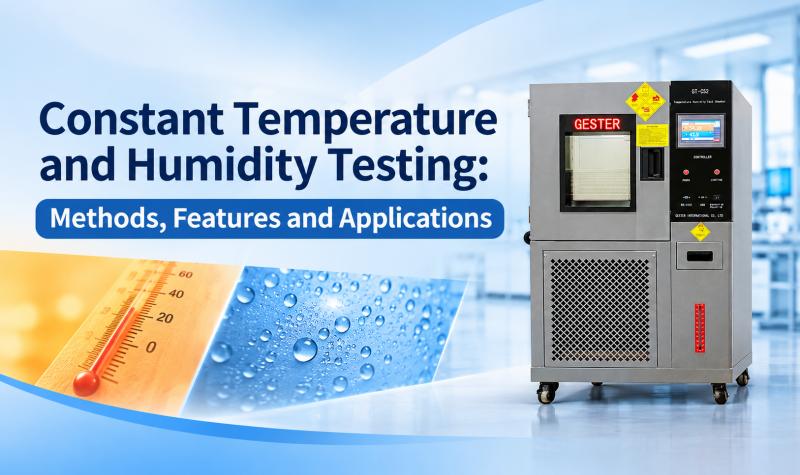
Constant Temperature and Humidity Testing: Methods, Features and Applications
Nov 10, 2026
What is Constant Temperature and Humidity Testing?
Constant temperature and humidity testing is a standard environmental testing method widely used across industries. It evaluates how materials and finished products perform under stable or programmed temperature‑humidity climatic conditions.
Product environmental adaptability and aging resistance are assessed by exposing specimens inside a closed test chamber to precisely‑controlled temperature and relative humidity for defined durations. This test reveals material degradation, performance drift, corrosion risk, sealing failure and electrical faults that may occur during real‑world storage, transportation and service life.
We perform constant temperature and humidity testing according to CNS, ISO, JIS, ASTM, DIN, BS, IEC, NACE, UL, and MIL standards. In this test, specimens are placed inside the chamber, and environmental conditions are maintained or cycled until the prescribed test duration completes or functional failure is observed.
Why is Constant Temperature‑Humidity Conditioning Important for Material and Product Validation?
The temperature and humidity change extremely gently. This test mainly evaluates the durability of products under a stable environment, such as whether electronic products will suffer short circuits, corrosion or other issues under high-temperature and high-humidity conditions.
Applicable industries: electronics and electrical appliances, medical devices, textiles, food packaging, furniture and most other industries. Examples include battery life testing of mobile phones under high-temperature and high-humidity conditions, moisture resistance & deformation testing of textiles, and moisture barrier performance testing of food packaging.
Standard Methods for Constant Temperature and Humidity Testing
Overview of CNS, ISO, JIS, ASTM, DIN, BS, IEC, NACE, UL, MIL and Related Standards
A suite of globally recognised standards including CNS, ISO, JIS, ASTM, DIN, BS, IEC, NACE, UL and MIL defines formal procedures for constant damp‑heat exposure and specimen pre‑conditioning. These standards govern chamber climatic setpoints, exposure rules, uniformity requirements and acceptance criteria while specimens remain inside the controlled test volume.
Constant Temperature‑Humidity Test Equipment and Tools
Types of Constant Temperature‑Humidity Chambers (Benchtop, Floor‑Standing, Walk‑In)
There are three main variants of temperature‑humidity chambers available on the market: benchtop, floor‑standing and walk‑in large‑volume chambers.
Benchtop Temperature and Humidity Chambers
Benchtop Temperature and Humidity Chambers are compact units suitable for laboratories with limited floor space and small‑size specimens. Typical capacity ranges from 20 L up to around 80 L. They save lab footprint yet still deliver full programmable control performance.
Floor-standing Temperature & Humidity Test Chambers
Floor‑standing models offer versatile internal capacities from 50 L to 1000 L for routine environmental‑reliability testing of medium‑sized samples. Most commercial laboratories select floor‑standing chambers for daily‑run qualification work.
Walk‑In Temperature‑Humidity Chambers
Walk-in Temperature and Humidity Chambers are large‑capacity environmental‑simulation systems designed for complete finished‑goods, big assemblies or simultaneous testing of numerous specimens. Operators can physically walk inside the test workspace to mount large‑size test articles. These are widely used in automotive, battery and aerospace projects.
All digital‑programmable chambers such as GESTER temperature humidity chamber GT‑C52 feature high accuracy and good result reproducibility. Automatic chambers are equipped with colour touch‑screen displays, multi‑segment programmable test profiles and built‑in data‑logging functions.
Common Industries Using Constant Temperature and Humidity Testing
Semiconductor Chips
We use constant temperature and humidity testing to verify reliability of wafers, IC chips and packaging components. It detects moisture-induced delamination, electrochemical migration and parameter drift under damp heat conditions, helping semiconductor manufacturers screen out potential defects before mass production.
New Energy Batteries
Constant temperature and humidity testing evaluates the stability of lithium-ion batteries, battery cells, modules and energy storage systems. It simulates humid and hot storage environments to check for swelling, sealing failure and capacity attenuation, ensuring battery safety and consistent performance across different climatic zones.
Electrical & Electronic Products
This climatic test is widely adopted for circuit boards, sensors, connectors and consumer electronics assemblies. It exposes electronic hardware to controlled temperature and humidity to validate insulation performance, prevent corrosion and confirm stable function over long-term service.
Aerospace
Aerospace components and structural materials undergo constant temperature and humidity testing to withstand harsh ground storage and high-humidity atmospheric conditions. It validates sealing integrity, coating stability and material ageing resistance to meet strict aerospace reliability specifications.
Mechanical & Electrical Products
Household appliances, motors, control panels and electromechanical assemblies rely on this test for qualification. It checks surface discoloration, rubber ageing, insulation degradation and mechanical fit changes under steady damp‑heat stress for home and industrial electromechanical goods.
Transportation & Automobile
Automotive ECUs, interior trims, sensors and on‑board electronic parts are tested in constant temperature and humidity chambers. The test simulates hot and humid parking and working environments to confirm no functional failure, coating peeling or dimensional deformation for vehicle components.
Features to Look for in a Constant Temperature‑Humidity Test Chamber
When selecting a temperature‑humidity environmental chamber, consider the following features:
Temperature‑Humidity Working Range
Common laboratory‑grade chambers offer temperature coverage from ‑60 °C to +150 °C and humidity from 20 %RH‑98 %RH. Some projects require custom‑extended temperature limitsGester.
Control Precision & Uniformity
Check temperature fluctuation, temperature uniformity and humidity deviation specifications. Good‑quality equipment maintains tight deviation across the usable workspace.
Chamber Capacity
Available test‑space options range from compact 20 L benchtop units through medium‑size floor‑standing chambers up to walk‑in‑scale volumes above 1000 L. Custom‑sized internal dimensions can be ordered to match special testing demands.
Programmable Profile Function
Multi‑segment programming capability allows users to edit complex ramp‑hold climatic cycles, simulating real‑world day‑night temperature‑humidity variation.
Data Output
There should be USB‑port or network connection for exporting test‑run reports. GESTER Temperature and Humidity Tester GT‑C52 supports USB‑based data export for easy post‑test data review and documentation.
Ease of Maintenance
Chamber spare parts should be readily accessible for routine maintenance. Water‑quality requirement for humidification system must be followed to avoid sensor contamination.
How to Perform a Constant Temperature‑Humidity Test?
Step‑by‑Step Testing Procedure
Laboratories carry out constant temperature‑humidity testing complying with IEC 60068‑2‑78, ASTM and related specifications. Inside the chamber, specimens are exposed to defined temperature‑humidity stress for preset duration.
Here is the detailed testing procedure step‑by‑step:
1. Place prepared test specimens inside the chamber workspace. Keep proper gaps between samples and chamber walls for air circulation.
2. Close and securely latch chamber doors to prevent internal climatic condition leakage.
3. On the touch‑screen controller, input target temperature, relative humidity value and total test duration. Program multi‑segment profiles if cyclic damp‑heat test is required.
4. Start chamber operation. Allow temperature and humidity to ramp gradually until set‑point conditions stabilise within chamber working volume.
5. Maintain stable climatic stress for full scheduled test duration. Conduct intermediate visual or functional inspections as required by test specification.
6. Once test time completes, stop chamber program, let chamber temperature return close to ambient, open door, retrieve specimens and record all observation data including appearance changes and functional‑test results.
Sample Preparation and Mounting
Specimen Pre‑Inspection and Conditioning
Before formal damp‑heat exposure, specimens shall undergo initial visual examination and baseline performance measurement. Some standards require pre‑conditioning under reference climate (such as 23 °C / 50 %RH) for specified hours before stress testing starts.
1. Sample cleaning: Remove surface dust, grease or residual manufacturing contaminants that could interfere with ageing‑test outcomes.
2. Avoid blocking airflow: Do not stack specimens tightly together. Keep clearance so circulating air can reach every surface of each sample.
3. Avoid direct contact with chamber metal walls: Prevent abnormal localised heat‑conduction influence over specimen temperature.
Proper sample preparation is essential to achieve accurate and repeatable test results.
Recording Results Accurately
Record specimen appearance, dimensional variation and functional‑performance data both before and after climatic exposure. Where intermediate checks are specified, log observations at each scheduled time‑point. For statistical reliability, repeat the full test on multiple identical specimens and evaluate overall sample‑batch behaviour.
Common Mistakes to Avoid During Testing
1. Over‑loading chamber workspace: Too‑many samples block airflow and break temperature‑humidity uniformity.
2. Specimens touching inner chamber walls: Causes local temperature deviation and misleading ageing behaviour.
3. Skipping pre‑test baseline functional measurement: No reference data to judge post‑test performance shift.
4. Neglecting regular chamber calibration and sensor verification, leading to incorrect actual climatic conditions.
5. Opening chamber door frequently during running test: This severely disturbs internal stable temperature‑humidity environment.
Contact Us for a Free Demo or Consultation
For more information on environmental‑testing methods and international‑standard compliance.
For temperature‑humidity‑chamber instruments such as GESTER GT‑C52 Constant Temperature and Humidity Test Chamber series, please reach out to our sales‑and‑technical team, who will help you identify suitable testing‑system solutions.
FAQs About Constant Temperature and Humidity Testing
How is constant temperature‑humidity testing performed for specimens?
Constant temperature‑humidity testing is performed inside a programmable climate chamber. Specimens are properly arranged inside workspace, doors are closed, target temperature‑humidity‑duration parameters are programmed into controller. Chamber stabilises climatic conditions and maintains stress for required time following standards. Baseline and post‑test specimen conditions are fully recorded.
What is the difference between constant temperature‑humidity exposure and simple high‑temperature‑only oven ageing?
Constant temperature‑humidity testing applies combined thermal plus moisture stress; moisture accelerates corrosion, hydrolysis and coating‑delamination failure modes. High‑temperature‑only dry oven ageing applies thermal stress without humidity load, and cannot reproduce moisture‑driven degradation mechanisms.
Are there fixed universal pass‑fail condition values for constant temperature‑humidity testing?
No universal single set‑point exists. Acceptable temperature‑humidity severity and required test duration are defined by product‑family specifications. For example consumer electronics, automotive components and military hardware each have their own distinct qualification requirements.
Can I manually calculate specimen‑ageing degree from chamber logged data?
There is no simple universal formula to directly compute real‑world service‑life purely from chamber log data. Accelerated‑test outcomes serve as comparative‑qualification evidence rather than direct‑life‑prediction tool. Real‑world service‑life estimation requires additional industry‑specific acceleration‑model knowledge.
Does higher temperature‑humidity setting always mean better‑quality validation?
Higher temperature‑humidity creates stronger accelerated stress, but over‑severe conditions may trigger artificial failure modes that never occur in real‑world usage. Test conditions must match relevant product‑standard specifications to deliver meaningful evaluation results.
Read More