
Leave A Message
If you are interested in our products and want to know more details,please leave a message here,we will reply you as soon as we can.

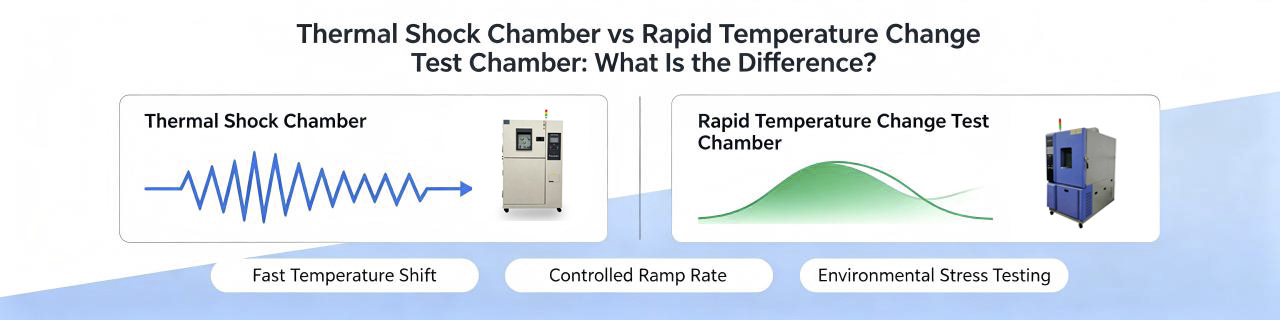
In environmental reliability testing, test failure often is not a problem of operation, but a poor choice of test chamber. Different testing projects have different requirements for temperature‑changing mode, thermal stress severity, test standards and subsequent data evaluation. If the same chamber is used to cope with all test circumstances, it is prone to misleading test results or unstable product reliability assessment. Therefore, there is no real‑sense “universal temperature test chamber” for all thermal cycling tests. Only by matching the chamber with specific testing purposes and working conditions can you get more reliable test outputs.
In this article, we will focus on the GT‑F51 Rapid Temperature Change Test Chamber and GT‑F56A Thermal Shock Chamber, explain how to tell them apart and select the proper unit in different situations, helping you reduce test risks and improve testing reliability.

Before settling on a temperature test chamber, you need to figure out your core test objectives and applicable industry standards. These two types of chambers both perform high‑low temperature cycling, but their internal mechanical structures and temperature‑transition mechanisms are fundamentally different. This difference dictates that they generate completely different thermal stress on test samples.
A rapid temperature test equipment delivers continuous, gradient temperature shift inside one single test workspace. If the temperature ramping rate is set improperly, samples may suffer cumulative thermal fatigue. A thermal shock temperature chamber separates high‑temperature zone and low‑temperature zone into two independent compartments; specimens are physically transferred between hot and cold chambers to achieve abrupt temperature impact. It creates severe instant thermal differential stress for test articles.
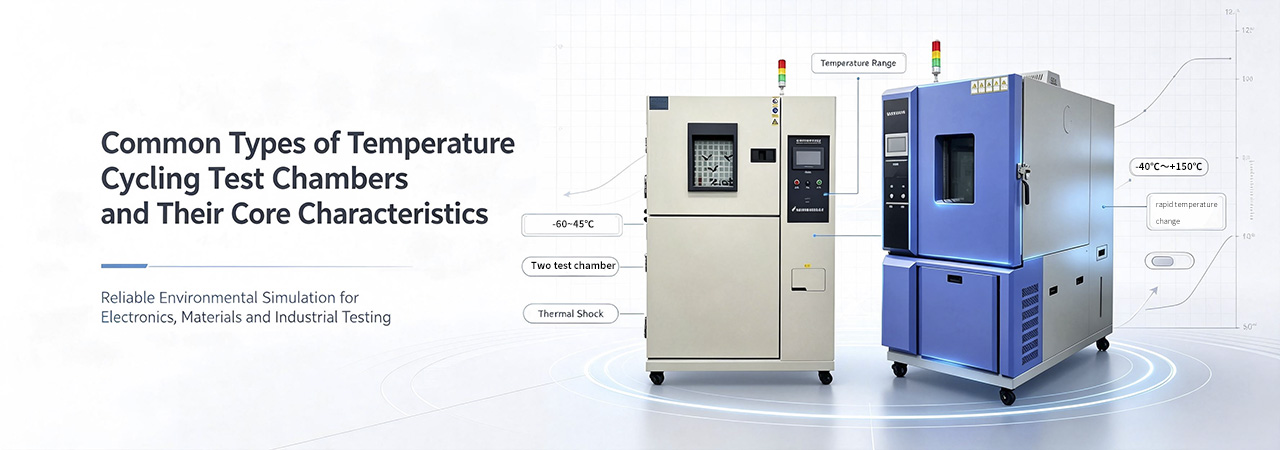
Common temperature cycling test chambers are designed with different emphasis and are therefore suitable for different testing projects. Understanding these differences will help you make more appropriate choices in actual lab operations, making your projects safer and more efficient.
The GT‑F51 rapid temperature test chamber is widely adopted for industrial‑product reliability testing mainly because of its precise and controllable linear heating and cooling rates. Temperature rises and falls continuously within a single test workspace, simulating gradual temperature fluctuations that products meet in real‑world service, storage and transportation environments.
This chamber adopts gas‑liquid bypass mode to regulate cooling capacity for energy‑saving constant temperature‑humidity control. It is equipped with a programmable color touch‑screen controller with PID control, supporting flexible recording and processing of test data. Key imported components guarantee long‑term service life and reliability, while an efficient oil separator protects compressor lifespan.
Its temperature range is ‑40℃~+150℃. Both heating and cooling rates can reach ≤10℃/min (linear, no‑load condition). Temperature uniformity is ±2.0℃ and temperature fluctuation reaches ±0.5℃. The standard load is 3 kg aluminum.
The GT‑F51 model is commonly used for electrical, electronic, mechanical products and material performance evaluation, covering consumer electronics, new‑energy components, auto parts and general‑purpose material aging tests. It can run long‑duration cyclic tests for assessing gradual thermal fatigue. It should be noted that this chamber cannot produce instant thermal shock effect. For projects requiring sharp abrupt temperature jump between isolated hot and cold zones, this equipment will not satisfy standard requirements.
The GT‑F56A thermal shock chamber consists of two fully independent compartments: a high‑temperature chamber and a low‑temperature chamber. Test specimens are placed inside a test basket and rapidly transferred between the two separated zones to create extreme instant temperature difference. This mechanism enables manufacturers to evaluate how abrupt temperature shifts impact product integrity and performance reliability.
Its high‑temperature chamber runs from RT+10℃ to 180℃, while the low‑temperature chamber covers ‑60℃~45℃. Temperature uniformity is ±2.0℃ and temperature fluctuation is ±0.5℃. The basket inner dimension is 600 × 500 × 500 mm. It features intuitive touch‑screen figure control interface for easy operation.
This thermal shock testing equipment is widely used for electronics and electrical components, automation parts, communication components, automotive parts, metals, chemical materials, plastics, defense‑industry hardware, aerospace components, BGA, PCB substrates, IC chips, semiconductor ceramics and polymer‑material testing. It targets physical damage and chemical property changes caused by extreme sudden temperature alternation.
Compared with therapid temperature change test chamber, the GT‑F56A thermal shock temperature chamber does not support slow gradient temperature‑ramping test inside one workspace. It focuses on generating violent thermal shock testing stress. It is superior for exposing hidden structural defects such as cracking, delamination and solder joint failure triggered by instant temperature jump. Note that this equipment cannot execute long‑term constant‑humidity aging tests as the rapid temperature change chamber does.

Your choice of test chamber should be based on your specific testing purpose. For example, if you need to simulate natural gradual temperature variations of electronic or new‑energy products during service and storage, the GT‑F51 rapid temperature change test chamber is the optimal solution. It effectively reproduces slow thermal fatigue and supports programmable humidity together with temperature profiles.
For aerospace, military or automotive critical components that need assessment against extreme instant temperature transition, the GT‑F56A thermal shock chamber is your best choice. It provides real thermal‑shock stress by sample physical transfer between separate hot/cold chambers, complying with military thermal‑shock test specifications.
If your test task requires both temperature cycling and humidity control for general‑purpose product validation, pick the rapid temperature change testing chamber. When you need to accelerate defect screening by sharp thermal impact without humidity requirements, thermal shock tester is more suitable.
Whether the chamber can deliver expected test results depends on whether you set proper test parameters. For rapid temperature change chamber, the core setting is heating/cooling rate. Too high ramping rate will introduce unintended heavy thermal stress to samples, while too low rate extends total test cycle time. For environmental thermal shock test equipment, specimen staying duration inside hot zone and cold zone matters most; insufficient dwell time prevents samples from reaching target extreme temperature.
During testing, you also need to control sample loading weight and sample layout inside workspace. Overloading will worsen temperature uniformity and distort test results. After test cycles finish, controlled sample recovery to ambient temperature is likewise required. If these test‑setup conditions are not ensured, even if you select the correct chamber model, you may get erratic test data, miss potential product defects or make wrong reliability judgements.
A rapid temperature change chamber can achieve fast gradient temperature shifting, but it cannot realize the physical transfer between isolated independent hot and cold compartments defined in thermal shock test standards. Even if you set its maximum 10℃/min ramping rate, it still belongs to continuous gradual temperature change. It is generally not recommended to substitute it for formal thermal‑shock qualification tests for safety‑critical projects.
For most tests targeting instant extreme temperature alternation, we usually recommend the GT‑F56A thermal shock testing machine. Because specimens are rapidly moved between separated high‑temperature and low‑temperature chambers, materials bear severe instant thermal shock test stress, which helps reveal hidden structural defects that gradient temperature cycling cannot expose.
Both chambers adopt touch‑screen programmable controllers. The rapid temperature test equipment supports programming of temperature‑ramping slope, dwell time and humidity parameters. The thermal shock chamber supports setting dwell time inside hot zone and cold zone, yet it cannot configure humidity conditions during thermal shock cycles.
Automotive components for general environmental‑adaptation cycling tests often adopt the GT‑F51 rapid temperature change test chamber. For aerospace, defense‑industry and high‑reliability automotive parts that need thermal‑shock qualification, the GT‑F56A thermal shock test chamber is the recommended option.
Selecting the right temperature test chamber is essentially a comprehensive judgment of test‑stress requirements, applicable standards and test‑object attributes. There is no one‑size‑fits‑all temperature chamber for all environmental‑reliability projects. Only by understanding the core characteristics of these two chamber types and matching them with specific application scenarios can you reduce invalid testing, improve stability and efficiency of lab validation work. Choose GESTER, our most professional engineers will give you the most professional solution according to your project needs!
What Is Thermal Shock Tester? & Why it is Important – Source: GESTER
Guidelines to Buy a Suitable Rapid Temperature Change Test Chamber GT-F51 – Source: GESTER
Thermal Shock Test Chamber: A Purchase Guide – Source: GESTER
The Different Types Of Temperature Chambers And How To Choose The Right One – Source: GESTER
leave a message
Scan to wechat :

Scan to Whatsapp :