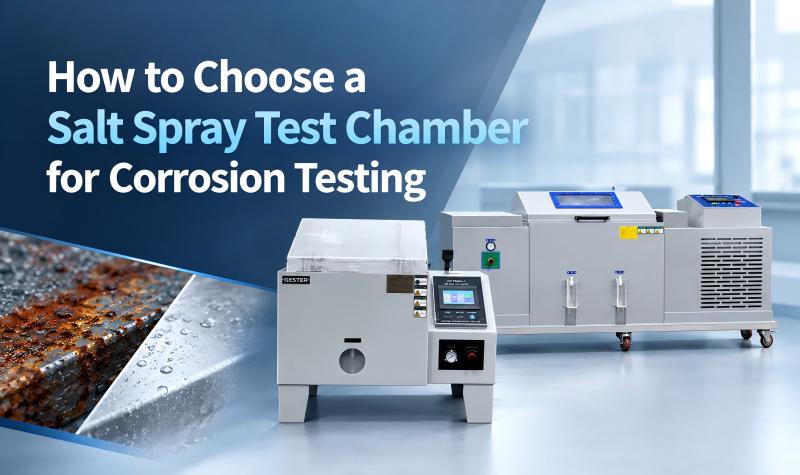
How to Choose a Salt Spray Test Chamber for Corrosion Testing
Sep 10, 2026
Not all salt spray test chambers are built for every corrosion-testing application. Therefore, you need a test chamber specifically designed to deliver repeatable, accurate corrosion test results.
For over many years, GESTER has been fabricating high-performance salt spray testing machines and salt spray test chambers. As an experienced test-equipment engineer at GESTER, I will explain how you can choose the right salt spray test chamber.
But first, let’s be clear on one important fact:
Why Corrosion Testing Requires Specialized Salt Spray Test Chambers
Like any other material-testing laboratory, industrial quality-control labs need reliable ways to evaluate anti-corrosion performance of metals, coatings, platings and surface finishes. That is where salt fog test equipment such as salt spray test chambers comes in.
Unfortunately, corrosion testing, whether for automotive, hardware, marine or electronic products, faces many sources of measurement uncertainty. It is one of the most critical quality-verification procedures for surface-treated components.
According to ISO and ASTM documentation, invalid corrosion-test reports are attributed to many factors. Among the key reasons is poorly performing salt spray machine hardware that cannot maintain stable test conditions.
Owing to the unique and demanding artificial corrosive atmosphere inside the chamber — full of salt mist, acid vapors, shifting temperature and humidity — you need a specially built salt spray test chamber.
Such salt spray chambers are tested to meet strict laboratory and industry standards. For instance, among the key salt-spray-chamber requirements is compliance with ISO, ASTM, and JIS standards.
In short, these salt spray test chambers must protect lab operators as a priority, alongside ensuring valid, repeatable corrosion-test data for your products.
Choosing Salt Spray Test Chamber for Corrosion Testing
For smooth, uninterrupted corrosion-testing workflows, you need a salt spray test chamber that can guarantee measurement stability and predictability. Besides, it must help reduce the total cost of laboratory operation.
Even though it is highly recommended to seek professional advice when buying salt spray test equipment, you must have certain information at hand. Here are 9 important factors to consider when buying salt spray test chambers.
1. Select the Right Chamber Construction Material
Look for a salt spray test chamber built with highly anti-corrosive inner tank materials. Ideally, heavy-duty PVC or PP composite delivers exceptional durability and salt-fog resistance.
PVC and PP inner chambers perform exceptionally well compared to other options such as ordinary steel or thin stainless steel chambers. For aggressive CASS or long-duration cyclic corrosion testing, 316L stainless steel wetted parts are strongly recommended. Apart from these qualified materials, other materials are not the perfect choice for harsh salt-fog laboratory environments.
High-quality PP / PVC material makes it a perfect chamber material for salt spray lab conditions. The material is easy to form while guaranteeing high strength, resistance to abrasion, superior salt-mist corrosion resistance, better chemical resistance against acetic acid and copper-accelerated solutions, and easy-to-maintain properties.
2. Chamber Design and Configuration
Salt spray test chambers must conform to a unique design and construction. The quality standards, such as uniform fog distribution, stable temperature control and consistent salt-solution delivery, all depend on the construction.
From experience, we design salt spray test chambers depending on the specific application. Of course, what kinds of samples you will test is also a determining factor here.
Here are some design guidelines:
Design must conform to stringent ISO, ASTM and JIS test-method regulations
Sloped roof design — sloped inner ceiling will prevent condensed salt solution from dripping directly onto test specimens
Thick anti-corrosive inner tank material to enhance chemical resistance and mechanical strength
Fully sealed chamber body with durable silicone gaskets to stop salt mist leakage
Easy-access cover or door with robust locking design
Modular design where applicable, for easy maintenance and component replacement (nozzles, solution reservoir, collection funnels)
High-precision anti-corrosion ceramic spray nozzles for uniform fog generation
Independent saturated air barrel for stable pre-heating of compressed air supply
Sample support racks, fog-collecting funnels, salt solution reservoir as core accessories
Other accessories that form part of the chamber design include over-temperature alarm systems, drainage valves, pH monitoring ports, liquid-level sensors, etc.
It does not matter whether you are buying standard salt spray tester, salt fog cabinet or compound salt spray test chamber. Every custom-configured chamber for corrosion testing must feature a robust construction based on any of the above guidelines.
Even when you want cyclic corrosion chambers that alternate salt-spray, humidity and drying phases, it is the construction that determines the suitability for this unique application.
3. Consider Supported Test Types (NSS, AASS, CASS, Compound Cyclic)
Salt spray chambers for corrosion testing must support correct test modes to match your product specifications.
Let’s summarize common salt-spray test modes for these chambers in the table below:
Test Modes for Salt Spray Test Chamber
Remarks
NSS (Neutral Salt Spray)
· Neutral 5% NaCl salt solution, 35 °C chamber temperature
· Widely used for general‑purpose corrosion resistance quality check
AASS (Acetic‑Acid Salt Spray)
· Acidified salt solution with acetic acid, controlled low‑pH environment
· For decorative electroplated coatings and surface finishes
CASS (Copper‑Accelerated Acetic‑Acid Salt Spray)
· Salt solution mixed with acetic acid and copper chloride, higher test temperature of 50 °C
· High‑aggressiveness test for automotive exterior decorative plating
Compound / Cyclic Corrosion Test
· Alternate cycles of salt spray, high‑humidity damp exposure and drying conditions
· Reproduce real‑world outdoor corrosion for more realistic assessment
Let’s put this into perspective:
Assuming you are looking for a chamber for routine hardware quality inspection, then a suitable selection can be basic NSS‑capable salt spray tester. On the other hand, in areas that are testing automotive decorative plating parts, the correct option would support AASS and CASS functions.
At the same time, if your lab needs to simulate real‑world coastal outdoor conditions, then you should choose compound cyclic salt spray test chamber.
Remember, all these functional capabilities will eventually determine the salt spray test chamber price.
As you can see, the whole idea here is to ensure the chamber you are choosing for corrosion testing can generate correct corrosive atmosphere matching product standards. Therefore, they must have unique solution‑delivery and temperature‑control mechanisms. Besides, the construction must prevent chamber‑material degradation from contaminating test specimens.
4. Verify International Standard Compliance
If you are performing third‑party‑report‑oriented corrosion testing, then basic NSS function alone may not be enough. There are specific industry standards that these chambers must comply with.
Remember, different product sectors reference different global corrosion‑test standards. These are high‑requirement lab applications that need specially designed salt spray chamber systems.
Among these key salt spray chamber standards are:
‑ ISO 9227 ‑ ASTM B117, ASTM G85 ‑ JIS Z 2371
Therefore, even as you choose custom anti‑corrosion chambers for harsh lab environments, they must satisfy these critical standard requirements. But more importantly, before you buy such chambers for your laboratory environment, ensure you get quality calibration and performance test reports.
5. Consider Your Actual Test Environment & Sample Conditions
Laboratory corrosion‑testing conditions vary greatly: long‑run continuous testing, high‑acid solution usage, large‑volume batch‑sample testing, limited lab floor space, to strict temperature limits.
That is why at Gester, we insist you do not settle for general‑purpose low‑grade test chambers. Your quality‑control lab requires chambers specifically fabricated for such demanding test conditions.
Let’s look at some requirements for salt spray chambers for different corrosion‑testing scenarios:
Corrosion‑Testing Scenario
Recommended Chamber Features & Test Modes
Automotive decorative plating parts
· Material: PVC / PP inner tank or 316L wetted components
· Supported test modes: NSS, AASS, CASS
· Rugged sealed construction for long continuous running
General hardware & surface‑coating quality‑control
· Material: PVC / PP inner tank
· NSS mode compliance to ISO 9227 and ASTM B117
Furthermore, your salt spray test chamber may have additional accessories such as:
‑ Data logging systems — Allow for recording temperature, test runtime and cycle status. Advanced systems store full test history for lab traceability.
‑ Over‑limit safety alarms — Helps protect samples and equipment during unattended long‑hour testing. Common mechanisms include over‑temperature alarm, low‑salt‑solution level warning, and power‑failure protection.
In short, an experienced test‑equipment engineer will help you customize a perfect salt spray test chamber for your unique laboratory environment.
6. Salt Spray Test Chamber Dimensions & Internal Capacity
You can choose from standard sizes or custom options. To choose the right size of salt spray test chamber for corrosion testing, you must consider:
‑ Number and physical size of test specimens to place inside the chamber
‑ Determine dimensions based on length (L) by width (W), by height (H) of the inner test workspace
‑ Calculate internal loading space and external footprint occupied in your laboratory
‑ Determine clearance within the chamber: specimens must not touch chamber walls, and must leave enough space for salt fog to circulate freely without blocking mist distribution.
Note: Always discuss the right chamber size with your test‑equipment manufacturer.
7. Safety & Operational Compliance
You need a salt spray test chamber in your laboratory to protect both lab personnel and guarantee credible test results. Always choose a chamber that has passed all quality testing and relevant standards.
Usually, these requirements may vary depending on your laboratory and product‑testing conditions. Some of the most common safety and operational compliance standards are:
‑ ISO 9227 ‑ ASTM B117 / ASTM G85 ‑ JIS Z 2371
‑ CE safety compliance for lab equipment
If possible, the manufacturer should support third‑party performance verification to ensure full compliance. Remember, you cannot compromise on safety and measurement reliability when it comes to salt spray test chambers for corrosion testing.
8. Specimens to Be Tested Inside the Chamber
The specimens you will load into the chamber depend on many variables in corrosion‑testing work. For instance, you may want to test plated metal hardware, painted components, electronic enclosures, automotive trim parts, fasteners, etc.
Again, knowing exactly what specimens you plan to test in the salt spray chamber will determine:
‑ Internal size and loading‑rack configuration
‑ Required test modes (NSS / AASS / CASS / cyclic compound test)
‑ Standard‑compliance requirements
‑ Overall chamber design and configuration
At times, each product category may require specific chamber functions fabricated for unique corrosion‑testing workflows.
9. Control System and Operation Features
Another important variable to consider is the chamber’s control interface and operating features. That is, how exactly will lab technicians set‑up, run and monitor corrosion tests within your laboratory workflow?
Common control and operating options include:
‑ Simple mechanical timer control for basic NSS testing
‑ Microprocessor‑based programmable controller for complex cyclic compound test sequences
‑ Local touch‑screen operation ‑ Built‑in test‑data logging function
With every control solution, the chamber will come with all the necessary accessories for daily test‑setup and maintenance processes.
Why Choose GESTER Salt Spray Test Chambers
With years of experience and research in fabricating high‑grade salt spray testers and corrosion cabinets, GESTER understands the strict accuracy and safety concerns of industrial and laboratory corrosion testing. Our salt spray test chambers feature heavy‑duty and robust anti‑corrosion construction.
We use high‑grade PVC / PP or optional 316L stainless‑steel wetted components, ensure all chambers comply with ISO, ASTM and JIS standards. Depending on your unique laboratory and specimen‑testing requirements, every salt spray chamber is customized to match your dynamic industrial and lab needs.
What’s more? Gester salt spray test chambers are known for a perfect balance between high quality and price. Tell us more about your corrosion‑testing project today, and our engineers will design and fabricate custom salt spray test chambers for your application.
Salt Spray Tester GT-F50BB
Salt Fog Chamber GT-F50BA
Compound Salt Spray Test Chamber GT-F50C
Read More