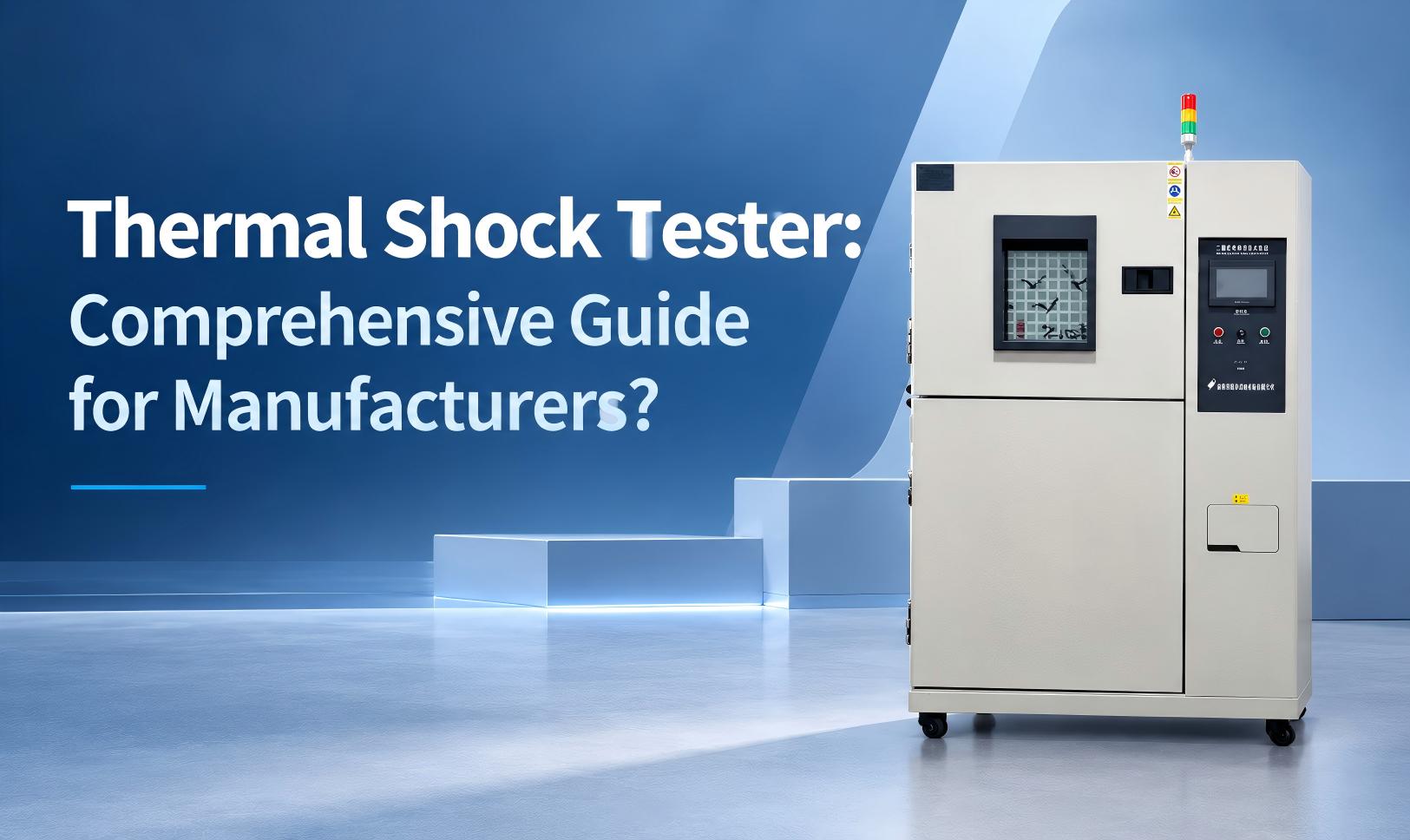
Thermal Shock Tester: Comprehensive Guide for Manufacturers
Sep 22, 2026
Thermal shock tester is widely adopted in manufacturing and quality-validation industries due to its versatile testing capacity. For its outstanding temperature switching performance, it is used in many industries as a source of reliability verification and efficiency for product development and quality inspection. A temperature shock testing machine is often selected when rapid temperature changes are required, while a thermal shock testing machine can provide controlled hot and cold environmental conditions.
Properties of Thermal Shock Tester
Thermal shock tester has the following notable features, making it fit for several testing scenarios.
Rapid Temperature Transition
Thermal shock tester delivers extremely fast shifts between extreme hot and cold conditions to test product performance. When test samples undergo sharp temperature alternations, hidden defects that cannot be detected in slow cycling tests will be exposed without extra manual intervention. This type of thermal shock testing is particularly useful for accelerated reliability evaluation.
Precise Temperature Control
It offers formidable temperature stability and is quite useful in those circumstances that demand accurate environmental simulation. It will be useful in projects where high repeatability is required for long-run testing cycles and there will be lesser vulnerability to temperature deviation. A thermal shock temperature chamber can provide the controlled conditions required for these demanding applications.
Fast Sample Switching & Temperature Recovery
GESTER Thermal shock tester completes sample transfer between hot zone and cold zone within short timeframes, paired with quick temperature recovery after each shift. This characteristic makes it fit to be used for accelerated reliability assessment for electronics, auto parts and other high-value components. The resulting environmental thermal shock test equipment can support repeated testing with consistent temperature transitions.
These properties make thermal shock tester to be easily applicable and sturdy for different product validation and laboratory projects.
Applications of Thermal Shock Tester
Thermal shock tester is favoured by many industries because it can simulate harsh real-world temperature fluctuations as well as offer stable control and is employed to detect potential failure risks of test articles. Here are some common applications:
Electronics Component Testing
For circuit boards, chips and complex electronic assemblies, you can use thermal shock tester. It has fast temperature switching and little control deviation, whereby it can well validate product stability under drastic thermal changes. Thermal shock testing equipment is commonly used for this type of component reliability assessment.
Automotive Parts Inspection
Thermal shock tester is commonly used in the manufacturing of automotive sensors and other vehicle components because of its ability to replicate strenuous high-low temperature cycles the parts are likely to face in service. A thermal shock test can help identify potential weaknesses before products are deployed.
Aerospace & Defense Product Verification
Thermal shock tester meets strict industrial testing standards, therefore suitable for performance check of aerospace and defense-grade components. You can reliably rely on it in support of your reliability-testing projects due to its testing repeatability.
Material Research Industry
Thermal shock tester is also utilized in material laboratories, in plants and in research facilities to observe material fatigue, cracking or structural changes caused by repeated thermal shocks. This makes thermal shock test equipment useful for evaluating materials exposed to repeated temperature changes.
Industrial Quality-Control Laboratories
For factories which require standardized accelerated environmental screening for finished goods, thermal shock tester has great switching speed and precise temperature regulation properties. A thermal shock machine can be integrated into laboratory quality-control processes according to the required testing specifications.
Advantages of Thermal Shock Tester
Here are the key advantages of Thermal Shock Tester:
Accelerated Defect Exposure
The rapid thermal cycling capability of thermal shock tester is robust, which makes this testing equipment capable of revealing latent product weaknesses. This makes it suitable for reliability validation and heavy-duty testing applications where quality verification and testing accuracy have the most importance.
Long-Term Operational Stability
Thermal shock tester gives end users lasting performance along with consistent control, characterizing its performance in continuous heavy-load testing tasks. It embraces high operational stability that tends to make you long-lasting in your testing operations, thereby minimizing unexpected downtime or component replacement frequencies.
Cost-Effectiveness
Thermal shock tester brings cost benefits to use since it accelerates product failure screening without lengthy field trials. This aspect of it makes its usage even more efficient, since it means you will spend less time on real-world field validation in the long run. When comparing thermal shock chamber price, users can also consider the long-term value provided by accelerated testing.
Ease of Operation & Maintenance
Thermal shock tester in terms of maintenance is relatively economical since minimum effort is needed for routine cleaning and checking for further equipment damage. This leads to reduced machine downtime and the offering of optimal testing services in several sectors within the industrial market.
Thermal shock tester is a stable and economical testing equipment that is used across many industries due to the precise temperature control it provides.
Choosing the Right Thermal Shock Tester
When choosing thermal shock tester for a particular industry, there are key points that should be put into consideration for maximum testing efficiency and service life. Here’s what you need to keep in mind:
Application Requirements
You should consider its use—will it be used for electronic component screening, automotive part validation, aerospace material testing, or routine batch inspection? Knowing the temperature range and cycle challenges that test samples are going to be subjected to helps determine the right chamber type (two-chamber or three-chamber) of thermal shock tester for your project. Understanding what is thermal shock test can also help users select the appropriate testing configuration for their applications.
Temperature Switching & Recovery Performance
Thermal shock tester promises fast sample transfer, offering stable temperature recovery for the long haul. These properties must align with your test part’s requirements, whether it’s ultra-rapid thermal transition or strict temperature tolerance. You want testing equipment that will simulate the toughest thermal conditions without compromising testing accuracy.
Test Chamber Capacity
If your test samples are large or you need multi-sample batch testing, you need thermal shock tester with appropriate inner chamber dimension. The base configuration of thermal shock tester can be adjusted to improve its performance, such as customized test baskets and trays. You should assess how well the machine will maintain its testing integrity under these load conditions. A temperature shock chamber can be selected according to the required sample capacity and test configuration.
Industry Testing Standards & Control System
It is also important to think about how manageable the machine is in terms of parameter setting and data output. Thermal shock tester is recognized for its programmable control and versatile testing mode, making it perfect for several compliance-testing applications. You’ll find it easier to work with when meeting industry standards for reliability and test-result traceability. When evaluating suppliers, thermal shock chamber manufacturers and thermal shock chamber distributors can provide different chamber configurations and technical support.
Selecting the thermal shock tester means considering the characteristics necessary for your particular application in the industrial setting for testing reliability and operational stability.
Conclusion
Thermal shock tester is useful when it comes to running high-performance reliability validation in the manufacturing and laboratory fields. It has rapid temperature switching, precise control, and stable cyclic operation to deliver a reliable testing outcome. Choosing high-quality thermal shock tester ensures long-lasting testing performance in your projects.
More Resources:
What Is Thermal Shock Tester? & Why it is Important
Thermal Shock Test Chamber: A Purchase Guide
Thermal Shock Chamber vs Rapid Temperature Change Test Chamber: What Is the Difference?
Read More